

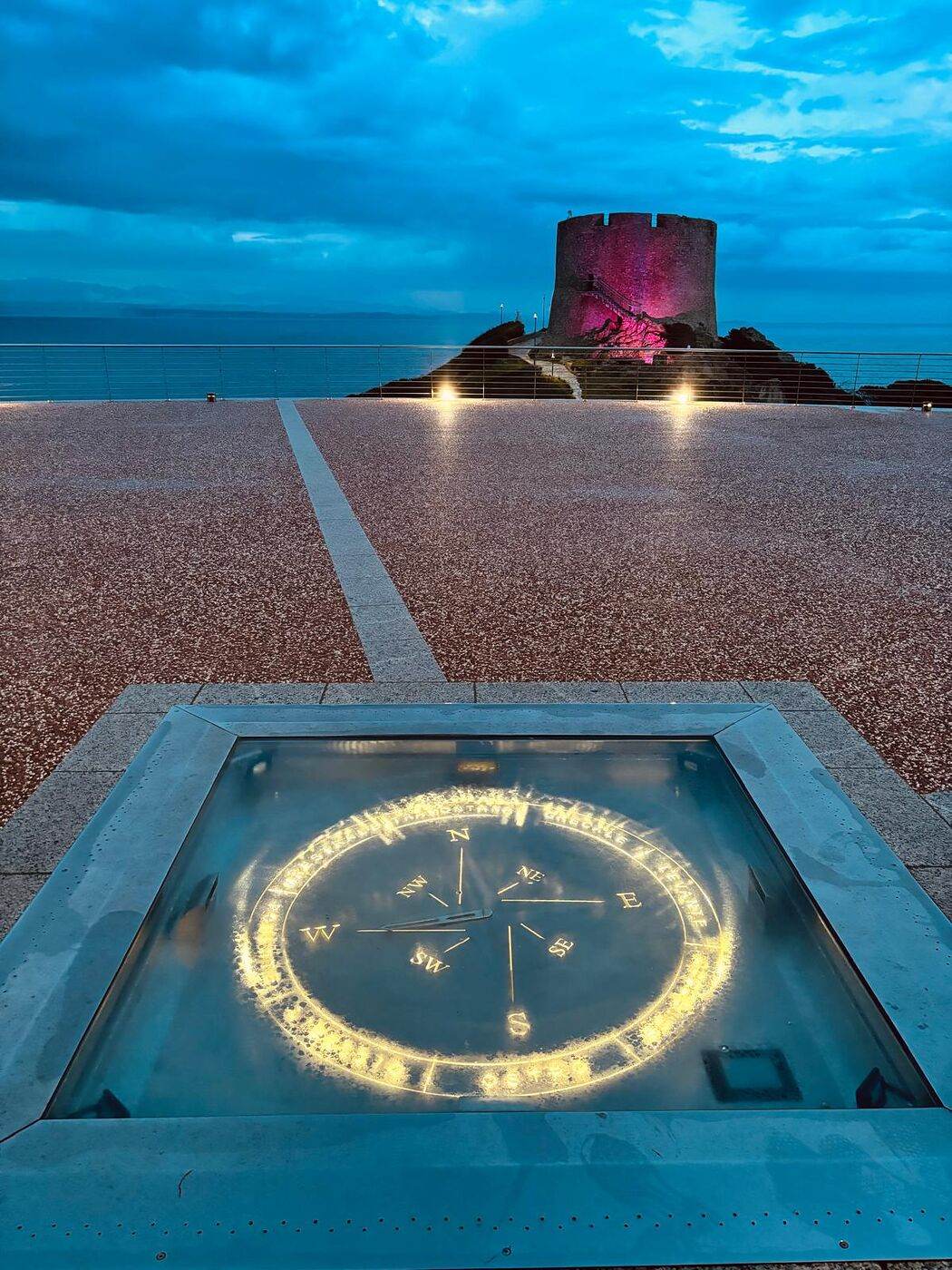
There's a tower at the southern tip of Sardinia that changes colour with the daylight. In the morning it's just pale stone against the sky. At night someone switches on a spotlight and it turns magenta against the deep blue of dusk — watching over a bay that has seen whole empires pass through without ever truly conquering it.
Because before any invader, before any tourist, there was a people archaeology still can't fully explain. More than three thousand years ago, the Nuragic civilisation raised seven thousand stone towers across the island — no mortar, no writing, no record of what they called themselves. Only the towers remain, scattered across the interior like unanswered questions. Then came the Phoenicians, the Romans, the Spanish — who built the coastal watchtowers to spot invaders arriving by sea, the same tower that today becomes a meeting point at sunset. Then came luxury tourism, which turned the north of the island into a millionaires' playground. Then mass tourism, which packed the most photographed beaches every July and August. And now, quietly, the digital nomads are arriving — the newest layer of an island that has always known how to take in newcomers without ceasing to be itself.
The Sardinia Nobody Shows You on the First Page of Google
The island that shows up in “most beautiful beaches in the Mediterranean” lists is real — but it's only the surface. Behind the turquoise water that has become a postcard cliché lies a network of stone villages, forgotten towers and a local life that keeps its own rhythm, indifferent to the mass-tourism calendar.
And something even more interesting is happening inland: whole communities fighting depopulation and deciding the answer might be to welcome outsiders. A village of just over a thousand people in the heart of Barbagia made international headlines by selling abandoned houses for one euro and launching a symbolic-rent programme for remote workers. The result: thousands of applications from every continent — and it's no longer alone. It isn't charity — it's smart survival. And it's proof that, for some places in Sardinia, the digital nomad isn't a threat to local authenticity. They're the ones helping to keep it alive. Which villages exactly, and what it takes to join that queue as a foreigner, is another story — but it's worth knowing it exists.
The Sardinia That Stays After Sunset
Most visitors treat Sardinia as a photo set: arrive by day, photograph the water, leave before the light changes. But it's after sunset that the island shows another face. The Spanish watchtowers are lit up and become quiet meeting points. No crowds. Just the sound of the sea, a metal compass rose set into the ground pointing to the four corners of the horizon, and the strangely rare feeling of being somewhere beautiful without being processed by it.
That's the hour when slow travel stops being theory. Whether you're in a van parked by an empty beach or in a little stone house rented for a month in an inland village, the effect is the same. Days stop being measured in sights ticked off a list and start being measured in light: the hour the sun rises behind the hills, the hour the heat peaks and everyone disappears indoors, the hour the temperature drops and life returns to the streets. That kind of moment is what separates visiting Sardinia from living it, even if only for a month.
Villages Tourism Hasn't Found Yet
Away from the fashionable coast, inland Sardinia holds entire villages built from pink and grey granite — architecture that seems to have grown straight out of the mountain rather than been built on it. Narrow lanes, squares just big enough for a single conversation, and a daily life that carries on exactly as it did before any travel guide mentioned the place.
It's in these villages that Sardinia gives what the fashionable coast can't: time — and welcome. Sardinians have a reputation for being wary of outsiders, but those who actually stay find the opposite: a hospitality that needs no performative smile, only time to prove itself genuine. The baker learns your name on the second visit, not the first. Your neighbour offers you olive oil from their own grove without anyone asking. And whoever decides to stay more than a night soon finds out that here, “doing nothing” is a full-time activity.
Why Staying Changes Everything
There's a huge difference between passing through a place and living in it — even for just a few weeks. Visitors collect photos. Those who stay learn the right hours to avoid the midday sun, find out which bakery still has warm bread at seven in the morning, and understand why Sardinians insist on a lunch that lasts twice as long as any tourist is used to.
Sardinia rewards those who slow down. And the south of the island — less crowded than the fashionable north, with villages literally inviting outsiders to stay — is exactly where that reward doesn't have a waiting list yet.
What This Article Didn't Tell You
Which village still has one-euro houses available. Which Cagliari neighbourhood has the fastest fibre without tourist prices. Exactly what time the baker pulls the bread out of the oven in each town on this route. That kind of detail doesn't fit in an article — it belongs to someone who lived there long enough to know.
The Living in Southern Sardinia guide is exactly that: the full map from someone who turned curiosity into a life change, with the names, prices and hours this piece only hinted at.
See the Living in Southern Sardinia guideJoin the community
New guides, stories and updates first, straight to your inbox. And soon, the Sasso Nomad community spaces.